

Dark stores are rapidly reshaping eCommerce and becoming the backbone of q-commerce (“quick commerce”) — ultra-fast delivery.
A dark store is built exclusively to serve the needs of eCommerce businesses and meet the rising expectations of online shoppers. These aren’t traditional supermarkets or warehouses. There are no display shelves or walk-in customers — only algorithms, pickers, and couriers. This format helps companies optimize urban logistics and gain a competitive edge.
In this guide, we’ll explain what a dark store is, who should adopt this model, how it works in practice, and which innovations are essential in 2025.
What Is a Dark Store in Simple Terms?
A dark store is a fulfillment hub designed solely for processing online orders. It looks like a typical store inside, but it’s closed to the public. Staff use it to pick items, pack them, and hand them off to couriers for delivery.
In practice, a dark store serves as a bridge between traditional retail and warehouses. It looks like a store but works like a fulfillment center — built not for browsing but for speed and precision.
Read more: How Marketplaces Deliver Orders: Order Fulfillment by Marketplace
The Origins of Dark Stores
Dark stores first appeared in the U.K. in the early 2000s. Sainsbury’s experimented with the format but shut down its pilot due to low order volume. The concept gained traction in 2009 when Tesco launched its first dark stores to handle the growing demand for online grocery delivery.
In the U.S., the model took off during the COVID-19 pandemic as players like Whole Foods (Amazon Fresh), Walmart, and Kroger converted parts of their stores into dark fulfillment centers to meet exploding demand for same-day delivery.
From early experiments to mass adoption during the pandemic, dark stores have shifted from a niche experiment to a mainstream logistics model. Today, they are no longer just a trend but a permanent part of retail infrastructure. This shift is also connected to the growing rise of dark shopping, where consumers expect instant, app-based purchasing with no physical store interaction.
Dark Store Statistics
As consumers increasingly expect groceries and essentials to arrive within hours, the scale of the dark store industry has grown from small regional pilots to a global logistics force. What started as experiments in the U.K. and U.S. has now become a multibillion-dollar market expanding across every continent. The acceleration in adoption reflects how retailers worldwide are rethinking last-mile delivery and building infrastructure around it.
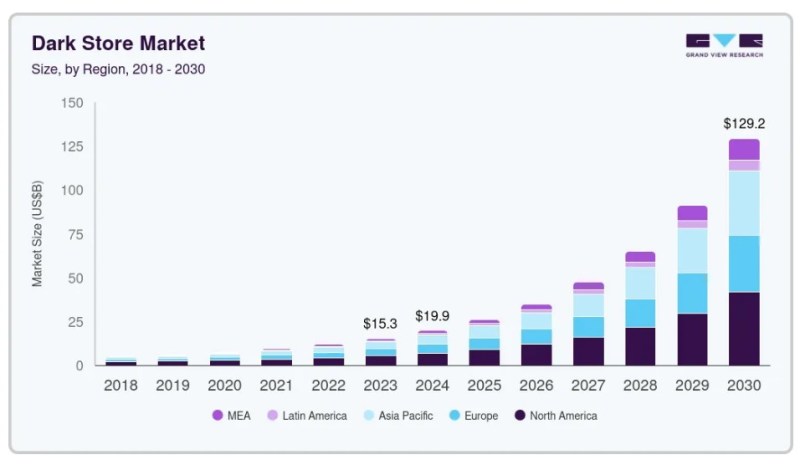
Source: Grand View Research
The visualization shows exponential growth: from just $15.3 billion in 2023 to an impressive $129.2 billion by 2030. North America and Europe dominate the market, while Asia Pacific also contributes significantly to the rise. The trend underscores that dark stores are no longer a niche concept but a central pillar of global eCommerce infrastructure. These numbers highlight how quickly the dark store market is expanding as global retailers shift to hyperlocal fulfillment.
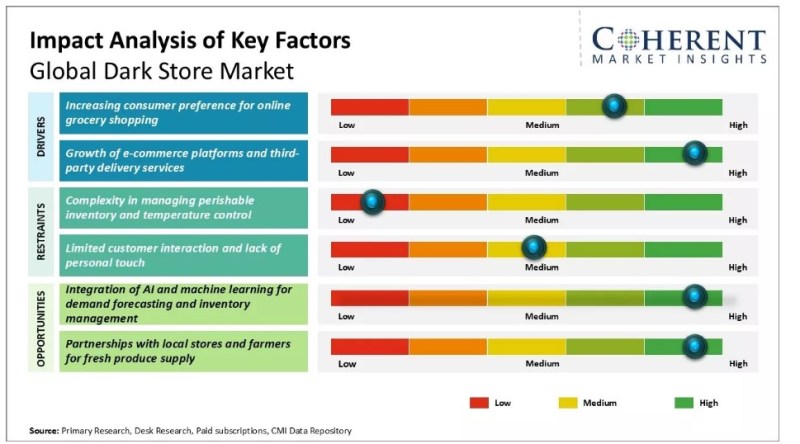
Source: Coherent Market
The analysis reveals that consumer preference for online grocery shopping and the rise of eCommerce platforms are strong drivers of growth. However, challenges remain, particularly with managing perishable goods and overcoming the lack of personal interaction. On the opportunity side, AI-powered demand forecasting and partnerships with local suppliers represent high-potential avenues. This shows that while operational hurdles exist, innovation and collaboration will shape the market’s evolution.
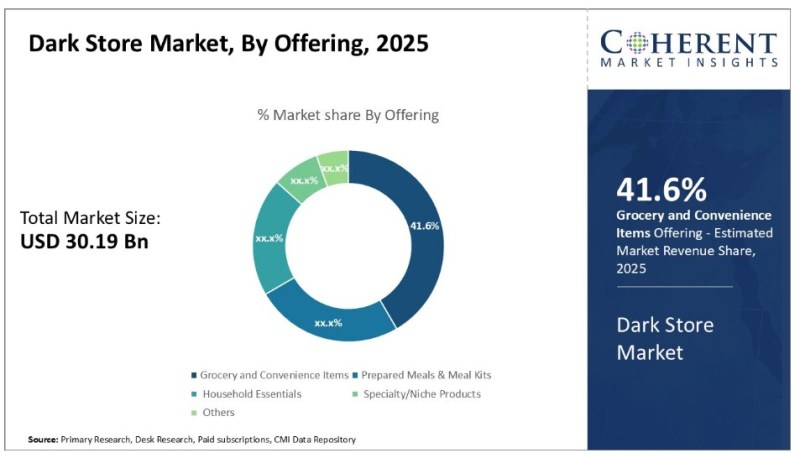
Source: Coherent Market
The data highlights that grocery and convenience items will account for 41.6% of the market share in 2025, making them the backbone of dark store revenue. Other categories, such as prepared meals, household essentials, and niche products, also play important roles but remain smaller in comparison. This confirms that the dark store business model is most effective for fast-moving consumer goods that benefit from quick delivery and frequent repeat purchases. Grocery remains the core category because the dark grocery store model is the most efficient for fast-moving daily essentials.
The trajectory of dark stores signals a deep transformation of retail. By shifting fulfillment closer to consumers and embedding technology into every step of the supply chain, retailers are creating a new standard for accessibility, speed, and convenience. The dark store model is actively shaping how consumers think about shopping in the future. It redefines modern commerce, where efficiency, data-driven decision-making, and customer-centric innovation converge.
Dark Store vs. Retail Store vs. Warehouse
At first glance, dark stores may seem like just another type of warehouse or retail outlet. However, their purpose and setup are fundamentally different — the table below highlights the contrasts.
| Parameter | Dark Store | Retail Store | Warehouse |
|---|---|---|---|
| Accessibility | Staff only | Open to shoppers | Staff only |
| Purpose | Picking and packing online orders | In-store sales | Bulk storage and distribution |
| Location | Near residential areas | Shopping districts | Often on city outskirts |
| Size | 1,000–10,000 sq ft (100–1000 m²) | From 2,000 sq ft+ | 10,000+ sq ft |
| Automation | High | Low | Medium |
The key difference from a store is that there are no physical customers, only online orders.
Key dark store vs warehouse difference: unlike warehouses that hold goods for retailers, dark stores actively process and fulfill consumer orders with last-mile logistics.
Learn more: Building an Omnichannel Fulfillment Strategy for Growing Businesses
How a Dark Store Works
This highly streamlined process is what enables ultra-fast delivery. Every step, from shelf layouts to courier routing, is optimized to save seconds — and minutes overall
Behind every 15-minute delivery is a carefully designed workflow. Here’s how a typical dark store processes an order from start to finish.
- A customer places an order via app or website.
- The system routes it to a picker.
- The picker gathers items using an optimized shelf layout.
- The order is packed and handed to delivery.
- A courier delivers it in 15–30 minutes.
Automation is central: algorithms forecast demand, reorder stock, and design shelf layouts to minimize picker travel. Frozen goods are placed near exits, slow movers at the back — everything is designed for speed.
Inside a Dark Store
Step inside a dark store and you’ll notice that it looks very different from a traditional supermarket. Instead of wide aisles for shoppers, every detail is optimized for speed and efficiency.
- Items arranged by popularity and size.
- Refrigerated and frozen sections instead of checkout lanes.
- Barcodes replace price tags.
- Routing software guides pickers.
- Advanced centers deploy ASRS (Automated Storage & Retrieval Systems) and robots to enhance operational efficiency.
To keep this machine running smoothly, dark stores rely on both people and technology.
Staff roles:
- Pickers collect items.
- Stock clerks track inventory.
- Couriers deliver orders.
- Robots and AI handle sorting, forecasting, and routing.
In 2025, expect more robot couriers, automated sorters, and AI-driven logistics aligned with the demand for instant delivery.
Leading Dark Store Operators in the U.S. & U.K. in 2025
Several major retailers have already embraced this model and are setting benchmarks for the industry. Let’s look at the key players.
Amazon Fresh
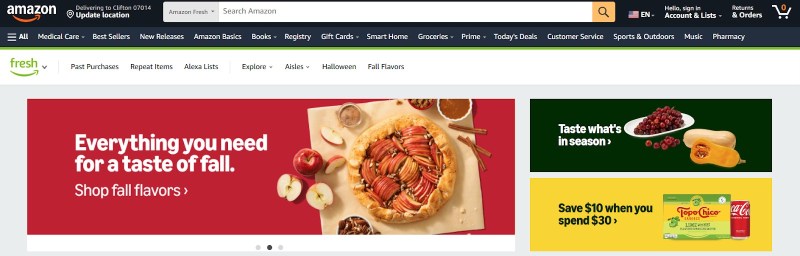
Using micro-fulfillment centers in major cities, offering same-day grocery delivery within 2 hours, with automation for stock control and AI-driven recommendations.
Learn more: Top 9 Fulfillment Companies for Marketplaces in 2025
Walmart Express Delivery
Over 4,000 stores double as hybrid dark stores, with micro-fulfillment tech to process orders in under 30 minutes.
Kroger Ocado Partnership

Highly automated fulfillment centers with AI-driven robotics capable of processing thousands of orders per day.
Instacart MFCs
Partnering with grocery chains across the U.S. to power rapid delivery via localized dark stores.
Tesco
Early European pioneers, now leaders in automated fulfillment and hyperlocal delivery.
These operators illustrate how flexible the dark store model can be, from micro-fulfillment in dense urban areas to large-scale automated centers processing thousands of orders a day.
Benefits of Dark Stores
Dark stores are particularly effective in industries where speed and freshness matter most. FMCG retailers and q-commerce players can use this model to guarantee ultra-fast delivery, while also reducing the costs associated with traditional retail spaces. However, the same features that make dark stores efficient also bring risks — from high automation costs to the risk of losing customer trust if delivery fails.
For Shoppers:
- Delivery in 15–30 minutes.
- Broad product selection.
- Seamless, contactless experience.
For Businesses:
- Lower rental costs vs. retail spaces.
- Streamlined logistics.
- High scalability.
- Faster turnaround times.
- Better control over inventory.
While the advantages are compelling — speed, efficiency, and scalability — dark stores are not a one-size-fits-all solution. The same factors that drive growth in q-commerce can become critical risks if demand is lower than expected or if logistics fail to keep pace.
Challenges & Risks:
- High upfront investment in automation.
- Limited space restricts the product range.
- Delivery failures hurt customer trust.
In practice, the benefits of dark stores are most visible in grocery, household goods, and other fast-moving categories. For these businesses, shaving even a few minutes off delivery time can directly boost customer loyalty. At the same time, companies must balance the gains with careful financial planning, as expensive technology and tight urban locations can extend the payback period.
Who Should Launch a Dark Store?
Not every business will benefit equally from the dark store model. Below are cases where it works best — and situations where it may fail.
Best fit:
- Retailers with fast-moving products (grocery, essentials).
- eCommerce businesses seeking urban logistics optimization.
- SMEs aiming to cut costs on large storefronts.
Best product categories:
- Food & beverages.
- Household essentials.
- Electronics & accessories with quick turnover.
Avoid launching in:
- Low-density regions.
- Markets with low demand for rapid delivery.
- Businesses without strong logistics or automation.
How to Launch a Dark Store
Launching a dark store requires careful planning but can be broken down into clear steps. Here’s a roadmap to get started.
- Select a location near densely populated neighborhoods for example where someone would look for an electronic parts store near me.
- Choose your product mix — groceries, daily essentials.
- Set up fulfillment workflows for picking & delivery.
- Automate your operations by choosing eCommerce automation software and integrating WMS, CRM, ERP, and routing systems.
- Train staff.
- Run marketing campaigns — local SEO, targeted ads, loyalty programs.
Read more: Marketplace Order Management Made Easy With a Multi-Vendor Platform
Infrastructure & Tech Needs
Technology is the backbone of a successful dark store. Without proper systems in place, even the best location and product mix won’t deliver the expected results.
- eCommerce platform with ability to scale over time: from MVP to a full-fledged store.
- Warehouse Management System (WMS).
- Integration with CRM/ERP.
- Courier routing & delivery platforms (e.g., DoorDash Drive, Uber Direct).
- High-speed internet and order processing software.
- B2B supplier onboarding portal for automated procurement.
Marketing Strategies for Dark Stores
Even the most efficient dark store won’t succeed without visibility. That’s why marketing plays a crucial role in attracting and retaining local customers.
- Targeted ads with discounts or cashback for first-time orders.
- Subscription models for repeat deliveries.
- Geo-marketing and local SEO for neighborhood visibility.
- Easy-to-use mobile apps and websites to retain customers.
Learn more: How to Arrange Money Flow on an eCommerce Marketplace
Dark Store Economics
Cost is often the biggest concern. While setup isn’t cheap, the investment pays off if demand is strong.
- Startup costs: $250K–$500K+ for a mid-size center.
- Monthly running costs: $20K–$50K (staff, rent, tech).
- Micro-dark stores can launch on lower budgets in small spaces.
Dark Store Trends for 2025
The dark store model is still evolving. Several key trends will shape its future in 2025 — from automation to hyper-localization.
- Robotics & AI are replacing manual labor.
- Hyper-local delivery in under 15 minutes.
- Marketplace integration — fulfillment + online storefront.
- Micro dark stores inside residential complexes.
- Omnichannel commerce — blending online/offline for seamless CX.
Should You Launch a Dark Store in 2025?
If your business relies on speed, product variety, and customer experience — yes. As consumer expectations rise, dark stores are emerging as a new standard in online retail logistics.
CS-Cart gives you everything you need to build, automate, and scale your dark store operations in one powerful platform:
- Multi-vendor marketplace support: onboard local suppliers and automate procurement.
- Real-time inventory & WMS integration: stay synced across all fulfillment points.
- Seamless delivery workflows: connect directly with courier APIs like DoorDash Drive, Uber Direct, and more.
- Custom storefronts & mobile apps: engage customers with an optimized ordering experience.
- Built-in marketing tools: run loyalty programs, local SEO, and promo campaigns from your dashboard.
CS-Cart can turn your scattered eCommerce tools into a complete online darkstore website that delivers a high-level customer experience.
All CS-Cart Products and Services
- ★ CS-Cart Multi-Vendor: free online demo
- ★ CS-Cart Store Builder: free online demo
- ★ Mobile App: App Store, Google Play
- ★ Customer Care: why it’s more than just a tech support
- ★ Upgrade subscription: select and reactivate