

For modern marketplaces, managing money flow is the foundation of trust between the platform, buyers, and sellers. As soon as a marketplace onboards multiple vendors, the business must answer a complex question: how to accept customer payments and distribute them to sellers accurately, instantly, and compliantly.
Traditional methods — collecting all payments into one merchant account and manually paying sellers later — no longer scale. They introduce delays, reconciliation errors, compliance risks, and vendor frustration. That’s why split payments have become a defining feature of a serious marketplace infrastructure.
This article explains how split payments work, how they differ from traditional payout models, and why they have become a core growth driver for modern multivendor platforms.
What Are Split Payments?
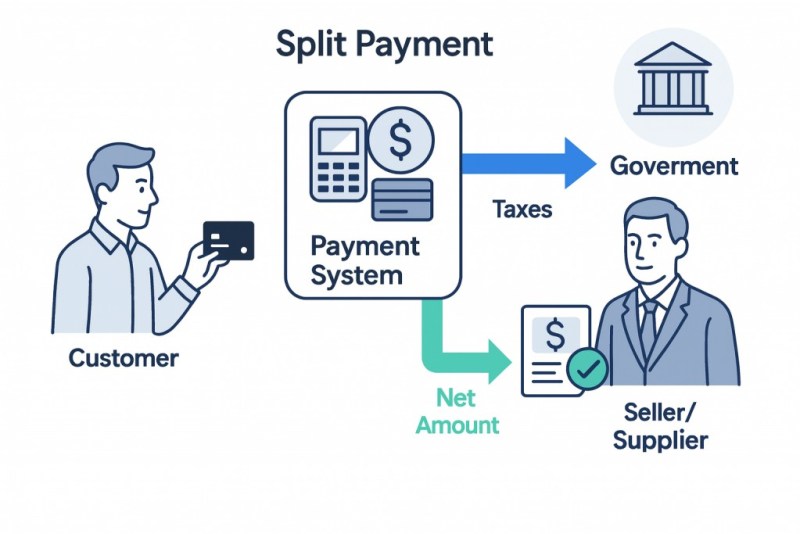
Split payments are a payment model in which a customer’s order is automatically divided among multiple sellers, the marketplace operator, and any additional fee recipients (e.g., logistics partners, tax authorities). Instead of routing the entire payment to a single account, the system allocates funds at checkout according to predefined rules.
Below are the platform types that use this principle:
- A marketplace selling as a multivendor (e.g., fashion, home goods)
- A platform charging commissions, subscriptions, or transaction fees
- B2B marketplaces with complex billing (wholesale prices, net terms, fees)
In short: split payments ensure that every participant gets paid correctly and instantly — without manual intervention.
You may also be interested in reading our articles:
- The Rise of B2B Marketplaces: Major Shifts Set to Shape 2025 in B2B eCommerce
- B2B eCommerce marketplace: Platforms, Building Guide, and Success Principles;
- 14 Best B2B eCommerce Software Solutions and Platforms in 2025.
Split Payments vs. Traditional Single Payouts in eCommerce
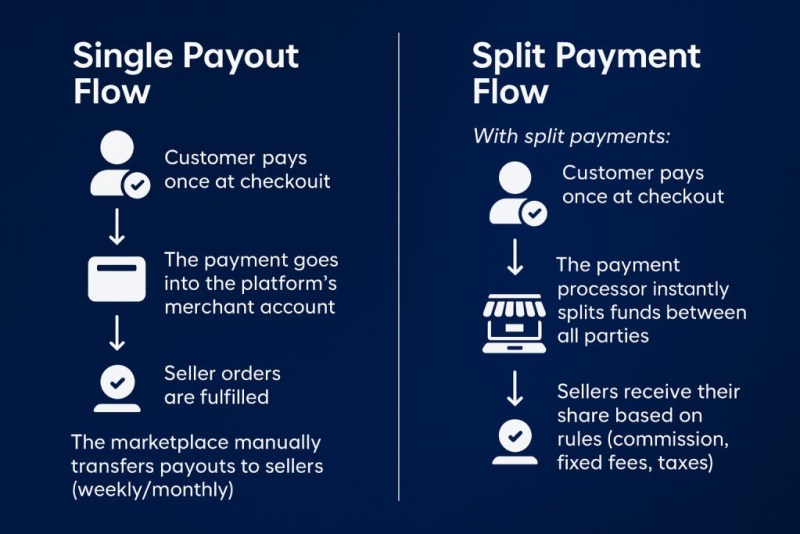
In a traditional setup, the entire flow revolves around the platform acting as the central financial intermediary:
Single Payout Flow
- The customer pays the platform.
- The payment goes into the platform’s merchant account.
- Seller orders are fulfilled.
- The marketplace manually transfers payouts to sellers (weekly/monthly).
Problems:
- Delayed payouts
- Heavy reconciliation workload
- Higher financial risk (platform holds funds)
- Compliance issues (money transmitter requirements vary per country)
- Sellers become dependent on the marketplace’s internal accounting
This model works for single-brand stores, but becomes impractical and hard to scale in multi-vendor environments. That’s why eCommerce split payments have become the default approach for modern marketplaces handling multiple sellers.
Split Payment Flow
In contrast, a split-payment system distributes the money the moment the buyer pays, which fundamentally changes how the marketplace operates::
- Customer pays once at checkout, using a credit or debit card, wallet, or any supported funding source.
- The payment processor instantly splits funds between all parties.
- Sellers receive their share according to rules (commissions, fixed fees, taxes).
- The marketplace receives its commission automatically.
Benefits:
- Instant or scheduled payouts with no manual work
- Transparent fee structure
- Lower financial and compliance risk
- Clean order accounting
- Happier sellers → easier onboarding → faster marketplace growth
In marketplaces, split payments are the infrastructure that enables multivendor operations.
Why Split Payments Are Becoming a Core Growth Driver for Marketplaces
Split payments support growth in ways that traditional payout models cannot:
1. Faster Seller Onboarding
New sellers are more willing to join when payouts are predictable and automated. That reliability is one of the main reasons sellers prefer marketplaces that support split payments online instead of delayed manual transfers. No manual accounting → fewer disputes → higher trust.
2. Automatic Monetization
Marketplaces can charge:
- percentage commissions
- fixed transaction fees
- service fees
- logistics fees
- subscription upgrades
All collected in real time at checkout.
Learn more about vendor commissions from our article: How Custom Commission Structures Can Help Retain Vendors and Maintain a Profitable Marketplace.
3. Operational Efficiency
Split payments eliminate:
- manual payout spreadsheets
- end-of-month reconciliations
- support tickets like “Where is my payout?”
Teams scale without expanding finance staff.
4. Regulatory Compliance
Many regions treat holding seller funds as money transmission and require licensing. Split payments reduce this risk because the marketplace never holds the money.
5. Better Cash Flow and Business Predictability
The marketplace receives its commission instantly. Revenue is more precise, more stable, and easier to forecast.
This is why leading marketplace platforms — including Uber, Etsy, and Airbnb — rely on split-payment engines at their core.
Read more in our article: What is the Best Way to Process Payments on a Marketplace.
How Split Payment Transactions Work
Split payments rely on a mix of routing logic, smart billing rules, and PSP (payment service provider) capabilities. Although the implementation varies by platform and gateway, the flow typically includes four layers. At its core, a split transaction distributes one customer payment across multiple recipients automatically work that’s often easier to ship reliably with banking app developers.
Payment Split Logic & Routing
At this stage, the system determines how the total payment should be allocated across all participants involved in the order::
- Vendor price
- Commission (fixed or percentage)
- Shipping cost allocation
- Taxes & VAT rules
- Platform service fees
- Refund rules
- Promo code distribution
Typical Routing Example
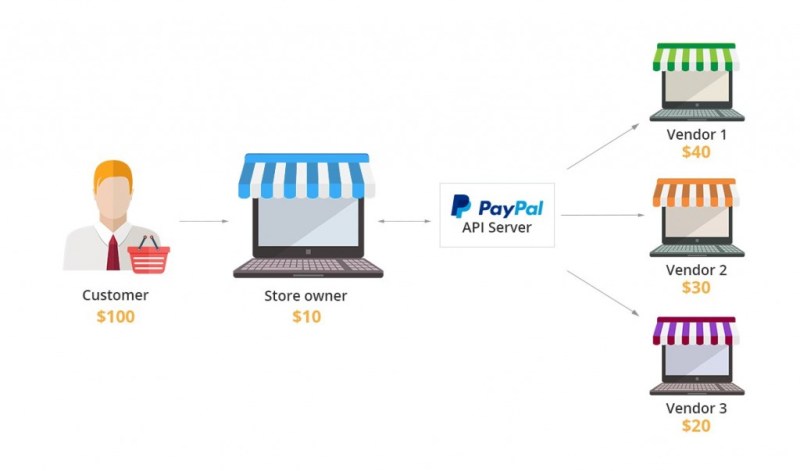
A buyer purchases from three sellers:
| Participant | Amount |
| Seller A | $45 |
| Seller B | $30 |
| Seller C | $25 |
| Marketplace Fee | $10 |
The processor (e.g., Stripe Connect, Adyen MarketPay, PayPal for Marketplaces) splits the transaction at checkout, sending funds into connected seller accounts and capturing commission for the marketplace.
Transaction Flow (Step-by-Step)
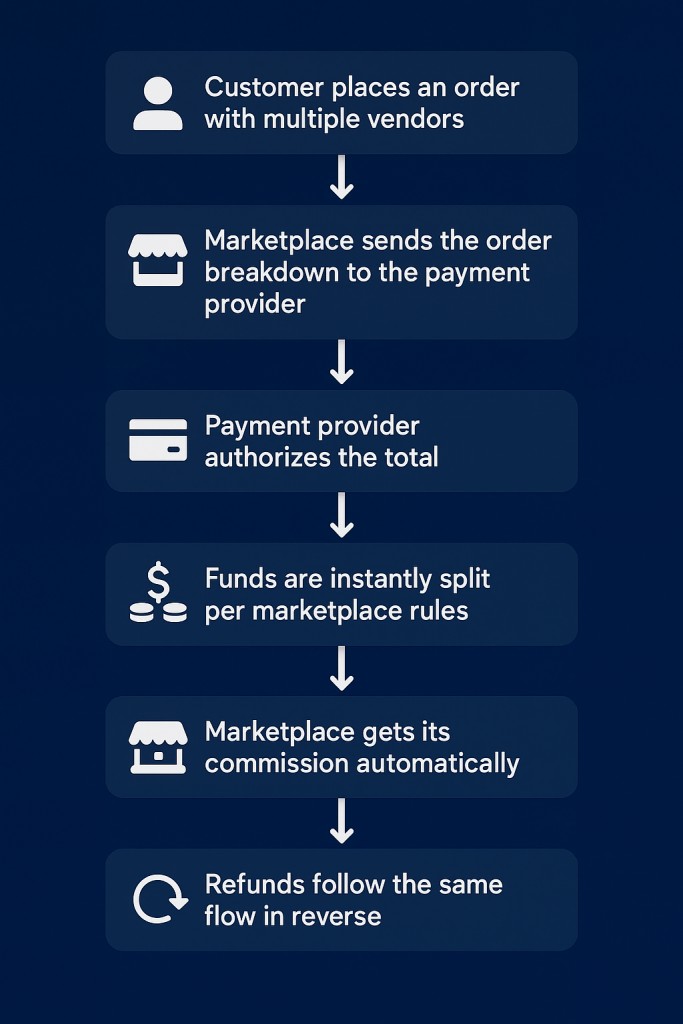
Here is the typical timeline for a split-payment order:
- Customer places an order with multiple vendors.
- Marketplace sends the order breakdown (items, sellers, fees) to the payment provider.
- The payment provider authorizes the total on the customer’s card or wallet.
- Funds are split instantly according to marketplace rules.
- Each seller receives their share, minus marketplace commissions.
- Marketplace receives its commission directly into its account.
- Refunds or adjustments follow the same routing logic in reverse.
This architecture keeps all participants paid accurately without storing seller funds on the marketplace.
Learn more from our article: CS-Cart Essentials: Monetary Relations with Vendors.
Split Billing Models for Multi-Vendor Marketplaces
Different marketplaces use different billing patterns depending on their business model. These patterns often rely on split billing, where fees, commissions, and vendor payouts are calculated and deducted automatically. The three most common are:
1. Commission-Based Billing (Most Common)
- Marketplace takes a percentage fee
- Sellers receive net amount
Ideal for consumer marketplaces, services, gig platforms
2. Mixed Billing (Commission + Subscription)
- The seller pays a monthly subscription
- Additional transaction fees are split at checkout
Used by professional B2B/B2C vendors
3. Invoice-Based Billing (Typical in B2B Marketplaces)
- Orders can be billed to corporate accounts
- Marketplace charges service fees separately
- Split payments may occur after purchase order approval
- Integrates with ERP / EDI workflows
These models may coexist on one platform — especially in hybrid B2C/B2B marketplaces.
Key Business Use Cases for Split Payments
Split payments have evolved from a niche financial mechanism into a foundational component of modern eCommerce, SaaS ecosystems, and multi-tender checkout. Below are the core scenarios where split-payment infrastructure unlocks real operational and financial advantages.
Online Marketplaces
Multivendor marketplaces were the first to adopt split payments at scale, but online retailers increasingly rely on the same mechanisms to streamline payouts and reduce manual accounting. Platforms like Amazon and eBay rely on this architecture to ensure transparent and accurate fund distribution between the marketplace and its sellers. This distribution happens even when multiple merchants contribute to a single purchase, keeping payouts accurate without extra processing steps. When a customer completes a checkout that includes products from several merchants, the system automatically calculates each participant’s share, deducts marketplace commissions, and directs the correct amounts to all recipients. This removes the need for manual reconciliation, prevents payout delays, and establishes a predictable, trust-based financial model for sellers who depend on consistent cash flow. This trust grows even further when platforms can accept split payments natively, reducing delays and eliminating manual payout steps.
The operational reality is simple: without split payments, handling thousands of independent merchants would become unmanageable. Automated routing keeps the marketplace lean and scalable, while reinforcing seller confidence — a critical factor for onboarding and retention.
Software Platforms and SaaS Marketplace Billing
Split payments are also gaining traction in software ecosystems, where a single customer invoice may include products or services from multiple vendors. In platforms like Salesforce and HubSpot, marketplace billing and revenue-sharing models allocate revenue between the core platform and connected third-party services. This allows customers to receive a single, consolidated invoice while ensuring each participating provider gets paid accurately.
For SaaS companies, this approach simplifies monetizing partner ecosystems. It eliminates the need for complex internal billing operations and gives partners confidence that their revenue share will be calculated and delivered reliably. As a result, ecosystems grow more quickly, integrations deepen, and the platform becomes more attractive to enterprise clients seeking unified procurement.
Multiple Payment Methods and Multi-Card Split Tender
Split payments do not only apply to distributing money among sellers or vendors — they also support scenarios in which the payer wants to divide the cost of a single order across multiple funding sources. CS-Cart, for example, allows customers to complete a purchase using two different credit cards or a combination of payment methods, such as a card plus a gift balance, QR-code payments or digital wallets.
This capability directly impacts conversion rates, and can increase sales by reducing checkout friction for buyers with limited balance on a single payment method. Customers facing limited card balances, budget constraints, or high-value purchases are less likely to abandon checkout if they can apply multiple methods to cover the remaining balance. This flexibility mirrors a digital bill split, reducing friction for buyers who need multiple funding sources. The underlying mechanism resembles traditional split payments: the system must intelligently route, authorize, and settle multiple transactions while treating them as parts of a unified order, effectively allowing the platform to divide transactions without breaking checkout flow. For expensive products, group gifting, or constrained personal budgets, split tender becomes a meaningful sales accelerator.
Payment Gateways That Simplify Split Workflows
Modern split-payment experiences rely on payment service providers that handle routing, risk, and compliance. These gateways enable various split payment methods, ranging from multi-vendor payouts to consumer-side split tender. For most platforms, choosing such a gateway is the fastest way to implement split payments without heavy engineering overhead. Several major gateways offer native support for split flows, enabling marketplaces and software platforms to implement complex payout logic without building financial infrastructure from scratch.
PayPal Complete Payments

PayPal supports split payments through its PayPal Commerce Platform. It allows platforms to route funds directly to sellers, with marketplace fees applied automatically at the moment of purchase. For CS-Cart users, there is a special add-on coming out of the box — PayPal Complete Payments add-on. It allows owners to accept and split payments between vendors. This solution is especially popular in many regions (with some exceptions) where PayPal is a default choice for cross-border commerce. Because PayPal is familiar to both consumers and merchants, marketplaces adopting this method often see higher seller acceptance and smoother onboarding.
Stripe Split Payments

Stripe Connect is widely regarded as one of the most flexible and developer-friendly solutions for split payments. Many marketplaces adopt Stripe specifically as their split payment gateway due to its global coverage and automated fee handling. It enables marketplaces to divide a single customer transaction between multiple recipients, automatically deducting marketplace commissions and sending funds to sellers according to predefined rules. Stripe also supports scheduled payouts, dynamic fee structures, and automated KYC for vendors, including verification of each seller’s bank account for secure transfers. Its architecture allows both high-growth startups and enterprise platforms to scale their payout logic globally without introducing operational overhead. If you want reliable split payments with Stripe Connect, use cards (including Apple Pay / Google Pay). Bank debits and BNPL work, but come with tradeoffs.
Get more insights from our article: PayPal vs. Stripe: Which Payment Solution is Best for Your Website?
Other Tools in the Split-Payment Ecosystem
Beyond the major gateways, several specialized tools address niche or advanced use cases in split-payment routing.

Kasheesh focuses on consumer-side split tender, allowing shoppers to combine multiple cards to complete a purchase — a helpful mechanism for high-ticket orders or situations where individual cards have insufficient balance.

Procore Pay approaches split payments from a construction-industry perspective, where multi-party billing, compliance requirements, and multistep approval workflows are shared.

Meanwhile, Finix offers a white-label payments infrastructure that provides businesses full control over fund flows, fee structures, and payout schedules, making it attractive for platforms that want to own their payment logic end-to-end.
These tools illustrate how diverse the split-payment landscape has become, expanding far beyond retail marketplaces into SaaS, fintech, and even industrial billing workflows.
Split Payments Implementation in CS-Cart
CS-Cart Multi-Vendor supports split payments through gateway add-ons such as Stripe Connect and PayPal Complete Payments (Multiparty). These providers handle the actual payout distribution, while CS-Cart sends them the commission calculations and routing instructions. This integration-driven approach lets marketplaces adopt digital split payments without building a payment infrastructure from scratch.
How the routing works
After checkout, CS-Cart calculates each vendor’s share based on:
— product subtotals
— taxes
— percentage or fixed commissions (including per-category rules)
Shipping can be included if enabled. CS-Cart handles all vendors within a single transaction, without forcing a separate payment flow for each store. For multivendor orders, CS-Cart generates separate instructions for each seller and forwards them to the payment provider. Refunds and cancellations follow the provider’s rules. Each refund is tied back to the original split payment transaction to preserve accounting accuracy.
Security
CS-Cart never stores card data. All sensitive payment processing happens on PCI-compliant gateways. Admin tools like roles and audit logs help with oversight, while Stripe or PayPal handles seller verification.
Flexibility and testing
Because split payments rely on add-ons, marketplaces can extend the logic with custom taxes, B2B workflows, or hybrid billing models, including support for partial payments, where needed. Testing is done through gateway sandboxes, and most issues stem from commission settings, add-on configuration, or the vendor’s PSP account status.
Key advantage
Founders can start with simple commissions and scale to more advanced payout models—without changing platforms—simply by configuring or extending existing integrations.
Get more insights about vendor onboarding, commissions, and payment workflows from the CS-Cart documentation.
Conclusion
Split payments have become one of the defining capabilities of modern eCommerce platforms, enabling marketplaces to accept a single customer payment and distribute funds transparently among multiple sellers. They streamline operations, reduce compliance risks, and create a financial environment where vendors are paid accurately and on time — a core requirement for marketplace trust and long-term growth.
As marketplaces expand into multivendor catalogs, SaaS ecosystems, B2B workflows, or multi-tender checkout experiences, traditional single-payout models quickly reach their limits. Split payments solve these challenges by providing predictable revenue allocation, real-time commission collection, and automated payouts at scale. Whether implemented through Stripe, PayPal, specialized tools, or an internal routing engine, the split-payment model forms the financial backbone of thriving marketplace ecosystems.
For founders building on CS-Cart, implementation becomes even more approachable. The platform offers structured billing logic, open-code customization, and integrations with leading payment providers — allowing businesses to adopt split payments early and refine them as they grow. With the right setup and iterative testing, split payments transform from a technical requirement into a strategic advantage, supporting sustainable expansion and a more professional, scalable marketplace operation.
All CS-Cart Products and Services
- ★ CS-Cart Multi-Vendor: free online demo
- ★ CS-Cart Store Builder: free online demo
- ★ Mobile App: App Store, Google Play
- ★ Customer Care: why it’s more than just a tech support
- ★ Upgrade subscription: select and reactivate