
Best Self-Hosted eCommerce Platforms Compared: Open Source Options You Can Fully Control
Choosing the right eCommerce platform today defines how easily you can customize workflows, scale operations, and adapt your business in the future. As companies move from small online stores to multi-brand ecosystems, B2B portals, or full-fledged marketplaces, many founders discover that SaaS tools no longer give them the control or freedom they need.
This is where self-hosted eCommerce platforms come in. They offer ownership, adaptability, and long-term scalability that cloud platforms cannot match. But they also require a different mindset: more responsibility, more customization, and a clearer understanding of how your eCommerce architecture should evolve.
In this article, we break down what a self-hosted platform is, how it compares to SaaS solutions, the benefits and trade-offs, and what “open source” really means for a growing online business.
What Is a Self-Hosted eCommerce Platform?
A self-hosted eCommerce platform is software that you install on your own server or hosting provider. Instead of renting infrastructure and features from a SaaS vendor, you own the environment where your store runs.
You decide:
- where the platform is hosted
- how it is configured
- what integrations to add
- how deeply you want to customize the code
- when to update and how your system evolves
Examples include Magento Open Source, Shopware Community Edition, WooCommerce (with custom hosting), and CS-Cart (on-premises versions).
A self-hosted platform behaves like a full eCommerce engine rather than a predefined toolkit. You get maximum flexibility, but also more responsibility for maintenance, updates, and performance.
How It Differs From Hosted (SaaS) Solutions
Hosted or SaaS eCommerce platforms — like Shopify, BigCommerce, or Wix — work differently. You rent the software, and the provider handles hosting, updates, security patches, and most of the technical complexity. A self-hosted webshop platform, by contrast, gives businesses direct access to hosting, configuration, and backend logic.
Key differences
| Aspect | SaaS Platforms | Self-Hosted Platforms |
| Infrastructure | Runs on the provider’s cloud. No access to the server or system configuration. | Runs on your own hosting. Full control over performance, security, and configuration. |
| Customization | Limited by platform rules, APIs, and allowed extensions. | Full access to the codebase with no restrictions on features, workflows, or integrations. |
| Data Ownership | Data is stored on third-party servers; export and access options may be limited. | Full ownership of databases, backups, and data access policies. |
| Scaling Model | Scaling depends on pricing tiers; traffic growth or custom workflows increase monthly costs. | Scaling depends on infrastructure — upgrade servers, not subscription plans. |
| Vendor Lock-In | High dependency on the provider’s roadmap, pricing, and technical limits. | Low dependency — you can change hosting, developers, or architecture freely. |
In short: SaaS offers convenience and speed of launch; self-hosted platforms offer freedom and long-term scalability.
Pros and Cons of Self-Hosted eCommerce
A balanced view — ideal for founders evaluating next steps.
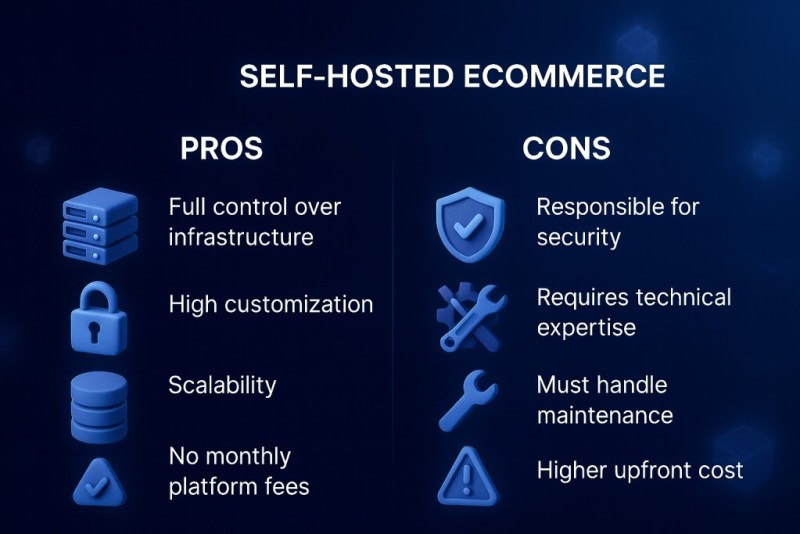
Pros
- Full Control Over Your Store. Every part of the stack — from server configuration to checkout logic — can be adapted to your business.
- Unlimited Customization. You can build exactly what you need: complex B2B rules, multi-storefront setups, custom seller logic, regional tax models, advanced analytics, and more.
- Open Code = No Artificial Limits. No forced pricing tiers or upgrade restrictions. You can integrate any API, add any module, or modify the core.
- Better Long-Term Economics. No growing monthly SaaS fees. You pay for hosting and development only when needed.
- Higher Data Privacy & Ownership. Particularly important for EU businesses under GDPR, large catalogs, or companies with internal BI.
- Ideal for Scaling Into B2B, Multi-Store, or Marketplace Models. SaaS tools struggle here — self-hosted platforms handle complex architectures better.
Learn more from our article: Five Reasons to Prefer Self-Hosted Ecommerce Software over SaaS.
Cons
- Requires Technical Management. You or your developer must handle server setup, updates, and performance monitoring.
- Higher Initial Setup Cost. More configuration at the beginning compared to a SaaS template.
- Responsibility for Security. Patches and server protection depend on you or your hosting provider.
- Development Needed for Major Changes. Deep customization is powerful but requires engineering resources.
- Not Always “Start in 1 Hour”. SaaS is faster for launching a small shop; self-hosted is an investment in infrastructure.
What “Open Source” Really Means for eCommerce
Many founders misunderstand this term. An open source eСommerce platform is not just about visible code — it is about architectural and business independence.
Open source means:
- You control the codebase. You can change any part of the platform to match your business logic.
- You’re not limited by a vendor’s roadmap. If you need a feature now, you can build it — not wait for a SaaS provider to release it next year.
- You get the freedom to integrate. ERP, CRM, PIM, WMS, shipping providers, B2B portals, custom workflows — nothing is blocked by permissions or API limitations.
- Long lifecycle. Open-source platforms stay relevant for 10+ years because you can evolve them as needed.
- Independence. You own your infrastructure, your product logic, your data, and your long-term scalability. Open source is freedom — the opposite of SaaS lock-in.
Why Businesses Choose Self-Hosted eCommerce
Self-hosted platforms continue to gain momentum among growing eCommerce companies, especially those expanding beyond a simple online store. The main reason is simple: they offer ownership and flexibility that SaaS platforms cannot match.
Below are the four core advantages that drive founders, CTOs, and eCommerce directors to choose a self-hosted solution.
Ownership, Flexibility, and Customization
For scaling companies, “owning the system” becomes a strategic advantage. A self-hosted platform lets you shape your infrastructure around your business.
Key advantages:
1. You own your environment. Everything from server configuration to caching systems, queues, databases, and CDNs is under your control.
2. Unlimited customization. You can build features that don’t exist out of the box:
- B2B pricing rules
- approval workflows
- custom checkout logic
- multi-step onboarding
- complex product attributes
- seller verification flows
- country-specific compliance logic
Nothing is blocked or restricted by a SaaS provider.
3. No dependency on vendor lock-ins. If a SaaS platform removes a feature, changes an API, or increases pricing, you have no influence. With self-hosted software, your business rules remain yours.
4. Faster innovation. You can launch new features, integrations, or storefronts immediately—without waiting for a SaaS vendor’s roadmap.
Scalability for Any Business Model
One of the biggest advantages of self-hosted platforms is that they can support any type of eCommerce architecture, even if your business changes direction later. An online store platform built on a self-hosted architecture can scale across regions, storefronts, and business models without structural limitations.
Self-hosted platforms scale better when you:
1. Expand internationally
- multiple currencies
- localization
- multi-warehouse logic
- tax and compliance differences
2. Launch new business models. Self-hosted solutions adapt easily when you grow from:
- B2C → B2B
- Single store → Multi-storefront
- Shop → Marketplace
- Retail → Subscription → Wholesale
SaaS platforms typically require switching to a higher pricing tier or migrating entirely.
3. Handle large catalogs or heavy traffic. High SKU counts, complex categories, or spikes during seasonal sales require strong server-level optimization—something SaaS cannot tailor per customer.
4. Integrate with internal systems. ERP, PIM, WMS, CRM, and BI tools often require custom logic and deep backend access. Self-hosted platforms are built for this.
Self-hosted architecture gives businesses freedom to grow in any direction without replacing the platform every few years.
Long-Term Cost Efficiency & Full Control Over TCO
For many founders, the biggest surprise is that SaaS becomes more expensive as the business grows.
Why self-hosted platforms often win on cost:
1. You don’t pay for revenue or sales volume. SaaS tools increase fees as:
- GMV grows
- the number of orders increases
- more staff accounts are added
- additional features are unlocked
Self-hosted platforms don’t penalize growth.
2. Predictable ownership costs. Your expenses depend on:
- hosting plan
- development when needed
- optional add-ons
There are no forced upgrades or percentage-based fees.
3. Longer platform lifespan. SaaS platforms may change pricing or discontinue plans. Self-hosted solutions can run for 5–10+ years with continuous improvements.
4. Better return on investment. Instead of paying recurring SaaS fees forever, you invest in your own infrastructure—an asset, not a subscription.
Over a 3–5 year horizon, a self-hosted platform often provides the lowest total cost of ownership (TCO), especially for mid-sized and enterprise-level businesses.
Read more about TCO in: Total Cost of Ownership (TCO) for eCommerce Software
Security, Compliance, and Data Protection
In regulated industries or regions with strict privacy laws, self-hosted architecture becomes a necessity—not just an option.
Key benefits:
1. Full control over data storage. You choose:
- where the data is stored
- how it is backed up
- who has access
Critical for GDPR, enterprise clients, and B2B environments.
2. Customizable security policies. You can implement:
- strict password policies
- MFA
- custom access roles
- firewall rules
- encrypted storage
- server-level protection
SaaS vendors offer uniform security for all customers—without room for customization.
3. Compliance with regional laws. For businesses operating in:
- the EU
- Middle East
- regulated health or financial sectors
- government contracts
Self-hosted solutions allow hosting within specific jurisdictions and aligning with local legal requirements.
4. Internal audits and monitoring. Since you control the entire stack, you can run your own:
- penetration tests
- intrusion detection systems (IDS)
- log audits
- vulnerability scans
This level of transparency is impossible with SaaS platforms.
You may also be interested in reading: How Online Marketplaces Ensure Personal Data Privacy
Best Self-Hosted eCommerce Platforms
Self-hosted eCommerce solutions vary widely in architecture, extensibility, and scalability. Below is an overview of leading platforms that offer open code, strong developer ecosystems, and the flexibility to build advanced business models such as multi-store, multivendor, or fully customized storefronts.
CS-Cart
CS-Cart is a mature, self-hosted eCommerce engine known for its clean, monolith architecture and PHP codebase, extensive backend customization options, and well-documented API. It supports B2C stores, B2B portals, and full multivendor marketplace architectures out of the box, making it a strong choice for companies preparing to expand into multiple storefronts or seller-based ecosystems.
The platform provides full access to the source code, predictable architecture patterns, and a wide extension ecosystem. Developers can modify any business logic—from checkout flows to vendor onboarding—and integrate external systems like ERPs, CRMs, PIMs, or custom internal services.
If you are looking for a self-hosted marketplace platform with a clean codebase, API support, and full backend customization, CS-Cart is one of the few solutions that meets all three criteria simultaneously while remaining production-ready out of the box.
Best for: Growing online stores, B2B operations, and businesses planning to evolve into multi-store or multivendor models.
WooCommerce
WooCommerce is a widely used WordPress-based solution that turns a CMS into an eCommerce system. It is open source, easy to start with, and supported by a massive plugin ecosystem. WooCommerce works well for small to mid-sized shops or content-heavy brands that need SEO-friendly storefronts.
However, the reliance on plugins can lead to maintenance overhead, and scaling beyond one storefront or a simple catalog may require significant optimization. WooCommerce offers REST API support, but deep backend reconfiguration is more complex due to WordPress’s plugin-based CMS architecture.
Best for: Content-driven stores, small to medium shops, and teams already familiar with WordPress.
Magento Open Source

Magento Open Source remains one of the most powerful and flexible eCommerce platforms available. It supports multi-storefront architecture, advanced catalog configurations, and custom integrations through a robust API system. Magento’s modular architecture allows developers to override almost any part of the logic.
The trade-off is complexity: hosting, performance tuning, and development require experienced engineers. Magento is well suited for enterprise-level requirements, large catalogs, and businesses that need deep customization and long-term scalability.
Best for: Large catalogs, global brands, B2B enterprises, and teams with solid development resources.
PrestaShop

PrestaShop provides a balanced middle ground: more structure and built-in features than frameworks, but less complexity than enterprise-grade platforms. It includes multi-store support, a sizable marketplace of modules, and access to core PHP code.
While PrestaShop can support mid-sized businesses, it may require plugins or custom development to achieve marketplace-level functionality or handle more advanced logic.
Best for: Medium-sized online stores and international brands wanting flexibility without heavy engineering overhead.
OpenCart

OpenCart is a lightweight, easy-to-host eCommerce platform with a simple architecture and multi-store native support. It is a good fit for smaller shops seeking a self-hosted solution without enterprise requirements.
Its extension ecosystem is large, but complex business rules, multivendor logic, or heavy integrations typically require substantial custom coding.
Best for: Small to mid-sized stores needing straightforward management and low server requirements.
Shopware

Shopware (especially Shopware 6) is a modern, API-first, Symfony-based platform designed with modularity in mind. It provides clean architecture, a headless-ready core, and strong B2C and content-commerce features. Its ecosystem is growing quickly in Europe, supported by good documentation and developer tooling.
Marketplace or multi-storefront setups are possible through plugins or custom development, though not as turnkey as platforms designed specifically for multivendor use.
Best for: Brands prioritizing modern architecture, storytelling-driven commerce, and headless flexibility.
Bagisto

Bagisto is a Laravel-based open-source platform known for its modern PHP stack and developer-friendly code structure. It offers built-in multi-store and multivendor capabilities via official extensions, making it attractive for teams wanting a more modern backend framework than traditional monolithic platforms.
Since it’s relatively young, the ecosystem is smaller, and more complex projects may require custom development.
Best for: Teams preferring Laravel, custom workflows, and modern PHP architecture.
Spree Commerce

Spree is a Ruby on Rails–based open-source framework aimed at developers who want full control over backend logic and storefront design. It is API-driven, modular, and suitable for headless or custom multichannel setups.
Because Spree is more a framework than a ready-made platform, businesses need developer resources to build essential features.
Best for: Custom architectures, Rails development teams, and headless commerce.
Saleor

Saleor is a GraphQL-first, Python/Django-based eCommerce platform designed to be headless and cloud-ready. It offers high performance and a clean architecture, making it strong for multi-channel or custom storefronts.
Its strength lies in flexibility rather than pre-built eCommerce features.
Best for: Businesses building custom frontends, PWAs, or modern headless ecosystems.
Medusa.js

Medusa.js is a Node.js-based open-source commerce engine built for developers who want maximum freedom. It provides APIs, event-driven architecture, and headless capabilities, making it suitable for building tailored experiences.
However, many core features require additional coding or plugins.
Best for: JS/Node-based teams building custom eCommerce workflows or microservices-driven stores.
Sylius

Sylius is an open-source Symfony eCommerce framework designed for full customization. It is not a plug-and-play shop, but a flexible foundation for building complex or highly unique eCommerce applications.
Ideal for businesses that don’t want to be constrained by predefined logic and prefer a “framework-first” rather than “platform-first” approach.
Best for: Complex, highly customized eCommerce applications and enterprises with strong developer teams.
How to Choose the Right Self-Hosted eCommerce Solution
Selecting a self-hosted platform is a long-term strategic decision that shapes how your business will scale, automate processes, and integrate with your broader digital ecosystem. Here are the core criteria to evaluate before you commit.
Technical Requirements & Hosting
Self-hosted platforms give you full control over infrastructure, but that also means you must ensure your hosting environment can support your business model.
1. Server Requirements
Different platforms vary in complexity:
- Lightweight systems (OpenCart, WooCommerce) run on basic hosting.
- Mid-tier solutions (PrestaShop, Bagisto, Shopware, CS-Cart) require optimized hosting and caching.
- Enterprise-level platforms (Magento, Sylius, Spree, Saleor) need strong servers, dedicated environments, and often DevOps expertise.
2. Performance & Scalability
If you expect:
- heavy traffic
- large catalogs
- multi-store setups
- marketplace operations — choose platforms designed to scale horizontally and vertically.
3. Security & Maintenance
Your team or hosting provider should be able to handle:
- regular updates
- security patches
- backups and monitoring
- SSL, firewalls, access control
If you do not have in-house technical staff, factor in the cost of a managed hosting provider or long-term development support.
Customization, Integrations & Ecosystem
One of the biggest advantages of self-hosted platforms is unlimited customization, but this varies widely among systems.
1. Codebase Flexibility
Ask: Can developers modify business logic easily and without workarounds?
- Platforms like CS-Cart, Magento, Shopware, Sylius, Bagisto, Spree, Saleor, Medusa.js offer strong backend extensibility.
- Simpler systems (OpenCart, WooCommerce) may require many plugins or workarounds for advanced logic.
2. API Coverage
Modern businesses rely on integrations with:
- ERP
- CRM
- WMS
- payment gateways
- analytics and BI tools
- marketplaces
- internal services
Choose a platform with:
- stable APIs
- event-based hooks
- webhooks
- clear documentation
3. Ecosystem & Marketplace
A strong ecosystem speeds up development:
- add-ons and extensions
- official integrations
- developer community
- professional services
- theme marketplaces
For example:
- WooCommerce → huge plugin ecosystem but requires careful quality control
- Magento → strong enterprise module ecosystem
- CS-Cart → marketplace tailored for advanced marketplace/business logic
- Shopware → quickly growing European ecosystem
Total Cost of Ownership (TCO)
The upfront license price is only a fraction of the long-term cost.
Key TCO factors:
- hosting expenses
- development hours
- extensions / modules
- upgrades & maintenance
- security & DevOps needs
- scaling infrastructure
- support (in-house or outsourced)
How to evaluate TCO realistically
- SaaS may be cheaper initially but grows costly with traffic, orders, or new features.
- Self-hosted platforms require initial setup but often become more economical over 3–5 years.
- Modern headless frameworks (Saleor, Medusa.js) are powerful but require significant engineering budgets.
- Platforms like CS-Cart, PrestaShop, Bagisto strike a balance between flexibility and affordable maintenance.
Your ideal choice depends on your technical resources, growth expectations, and automation needs.
Which Platform Is Best for Your Business Type?
Different business models have distinctly different requirements. Here’s a practical way to match platforms to your current and future needs. Whether a company needs a self-hosted webshop or a lighter solution depends on its growth stage, compliance needs, and technical resources.
| Business Scenario | Best-Fit Platforms | Why |
| Small Online Store or Content-Driven Brand | WooCommerce, OpenCart | Low hosting requirements, simple setup, large communities, strong SEO capabilities |
| Medium Online Store with Multi-Language or Multi-Currency Needs | PrestaShop, CS-Cart, Shopware, Bagisto | More out-of-the-box features, better scalability, cleaner architecture, growing ecosystems |
| Enterprise-Level Brand or Large Catalog | Magento Open Source, Shopware, Sylius, CS-Cart | Modular architecture, robust APIs, enterprise-grade performance tuning, strong developer ecosystems |
| Custom Headless or Multi-Channel Experience | Saleor, Medusa.js, Spree, CS-Cart | API-first design, modern tech stack, ideal for custom frontends and microservices architectures |
| Marketplace, Multi-Storefront, or Complex B2B/B2C Hybrid | CS-Cart, Bagisto, Magento | Native multivendor and multi-store logic, full backend customization, strong API support, ready-made marketplace workflows |
If your long-term plan includes launching a marketplace or managing multiple storefronts under one ecosystem, choose a platform engineered for this from the start — such as CS-Cart — rather than adapting a shop-only system later.
Get deeper insights about different platforms from:
- Which is the Best Marketplace Platform in 2025
- How to Choose the Right eCommerce Platform for Building Your Online Marketplace
Conclusion
Self-hosted eCommerce platforms offer the freedom, transparency, and scalability that growing businesses need — especially those expanding into new markets, launching multi-storefront setups, or adding marketplace and B2B capabilities.
Choosing a self-hosted platform is not just a tooling decision — it is an architectural commitment that defines how your business will evolve, scale, and adapt over the next several years. Lightweight systems are perfect for simple stores; enterprise-grade solutions handle complexity; API-first frameworks empower custom experiences; and specialized platforms like CS-Cart provide a scalable foundation for marketplaces and multi-store architectures.
The real question is not what your business needs today, but whether your platform can support future business models without forcing a costly migration or architectural reset. In practice, changing an eCommerce platform is rarely a technical task. It is a costly operational shift that affects teams, integrations, data, and customer experience. A well-chosen self-hosted architecture becomes the foundation of your digital business — one that you own, control, and can evolve without external constraints.
All CS-Cart Products and Services
- ★ CS-Cart Multi-Vendor: free online demo
- ★ CS-Cart Store Builder: free online demo
- ★ Mobile App: App Store, Google Play
- ★ Customer Care: why it’s more than just a tech support
- ★ Upgrade subscription: select and reactivate

Gayane is a passionate eCommerce expert with over 10 years in the industry. Her extensive experience includes marketplace management, digital marketing, and consumer behavior analysis. Dedicated to uncovering the latest eCommerce trends, she ensures her readers are always informed about industry developments. Known for her analytical skills and keen eye for detail, Gayane's articles provide actionable insights that help businesses and consumers navigate the ever-evolving digital commerce landscape.